Think
Judgment is the Job: Keeping the Human in AI for Architecture
5 min read
Twice a year, the leaders of America's largest architecture firms meet as the American Institute of Architects (AIA) Large Firm Roundtable (LFRT). On October 7th in Chicago, about 30 of those CEOs sat down with some 30 architecture deans and 30 of their students. The people hiring the next generation and the people teaching it were at the same tables.
I shared the stage with Kai-Uwe Bergmann, Partner at Bjarke Ingels Group (BIG), and Mariana Ibañez, Chair of Architecture and Urban Design at UCLA. I was the only person in the room building AI software for architects, there to offer a view on the future of practice. BIG asked me to bridge practice, software and academia, since I've worked at Foster + Partners, founded xFigura, and taught at Harvard and UPenn.
Kai ended on Rick Rubin, the producer behind some of the biggest records of the last forty years, who told 60 Minutes he has no technical ability. He can't even work the soundboard. What he's paid for is his taste. He listens and he knows what's good.
I believe architecture is heading the same way. AI will soon run the technical side of design (the soundboard). So, I asked the room: who teaches our students and young designers to listen? For an architect, listening means design judgment, knowing what good design is and why.
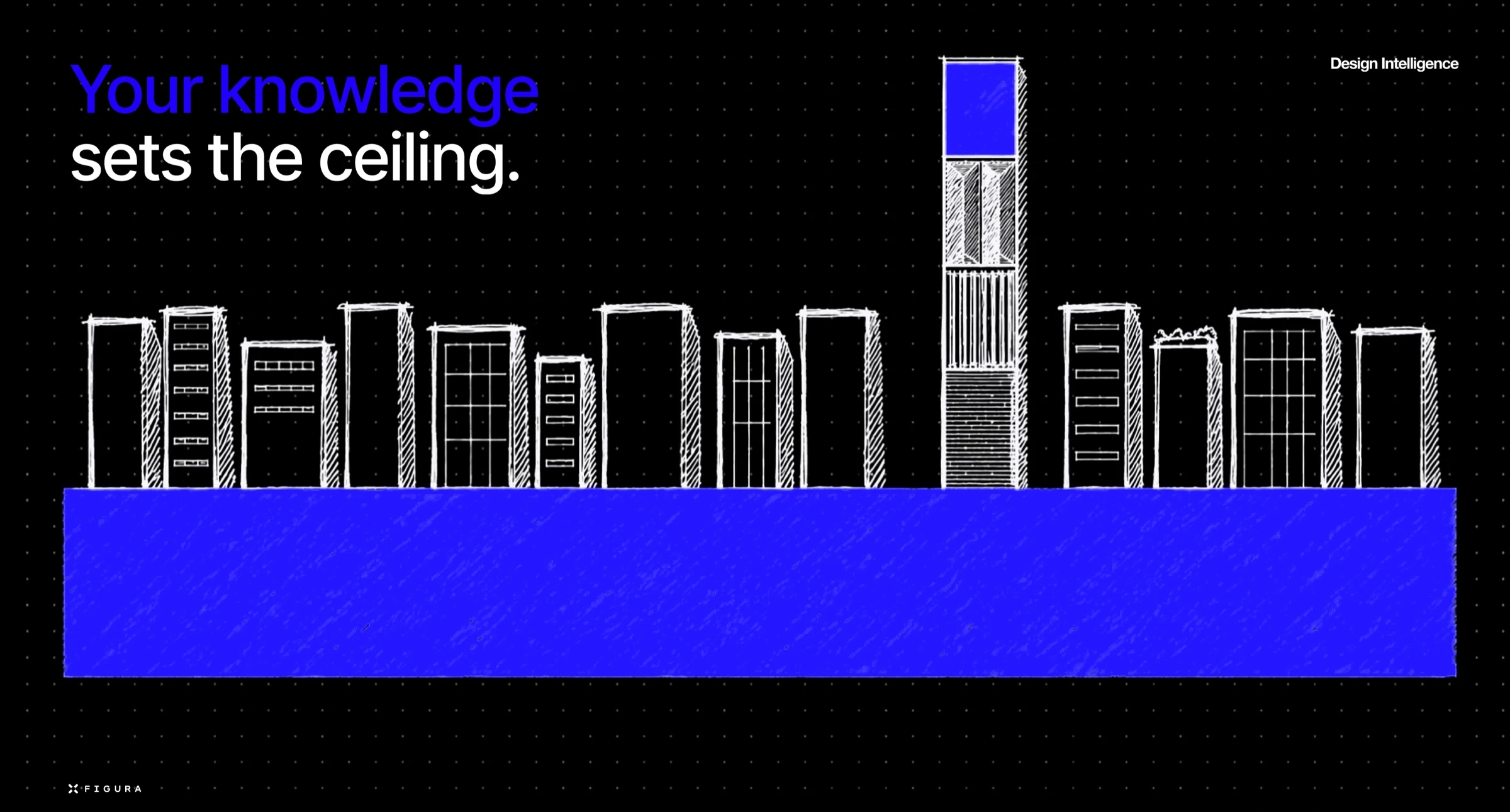
Judgment comes from knowledge. My bottom line is that knowledge sets the new ceiling. With every model arriving better and quicker than the last, we need to discuss critically what knowledge and judgment mean for the future of practice.
The tool sets the floor
For most of history, we built what our tools let us draw. Hand drawing gave us a way to document a design. CAD gave us precise geometry. BIM gave data to geometry, so the computer could analyze and optimize the model. AI is the first tool that generates ideas with us, moving the machine from analysis into creation.
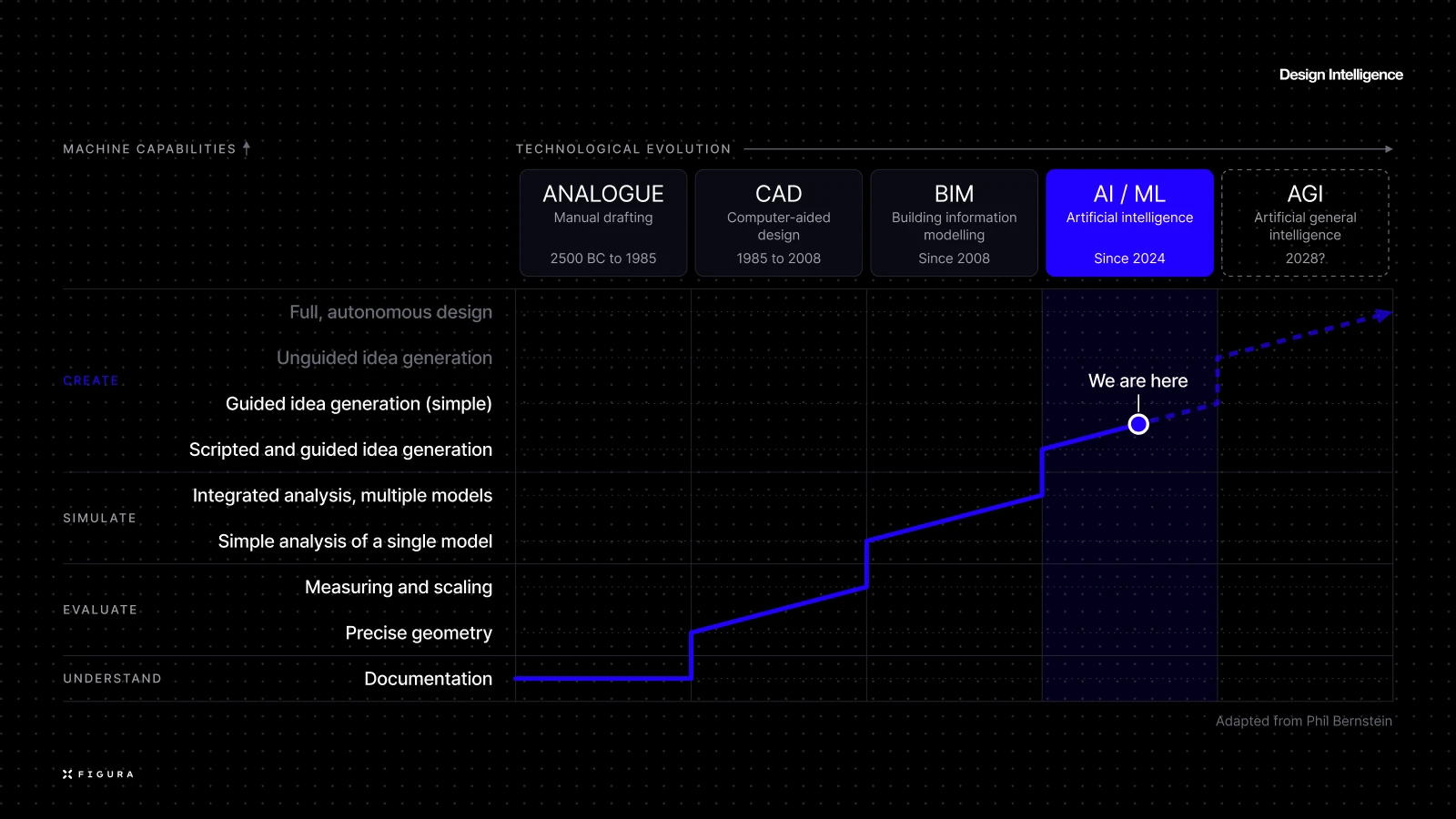
Each new tool raised what architects could build. Adapted from Phil Bernstein.
For a century, the tool set the ceiling: if you couldn't draw it, you couldn't design it, let alone build it. Now the tool sets the floor. An intern has the same tools as a partner, but what the intern doesn't have is the judgment. What sets a firm apart is knowledge: the buildings it has delivered, the experience it has accumulated, and the judgment it has cultivated. The question is how to capture that knowledge while keeping architects in control.
A tower, start to finish
xFigura is a web-based collaborative canvas for a project's entire pipeline, from first sketch to drawing set, where architects, consultants and clients work in one space, steered by humans and enabled by AI. Two years ago, going from a sketch to an editable 3D model in one AI workflow was a fuzzy idea. With agents, it's real.
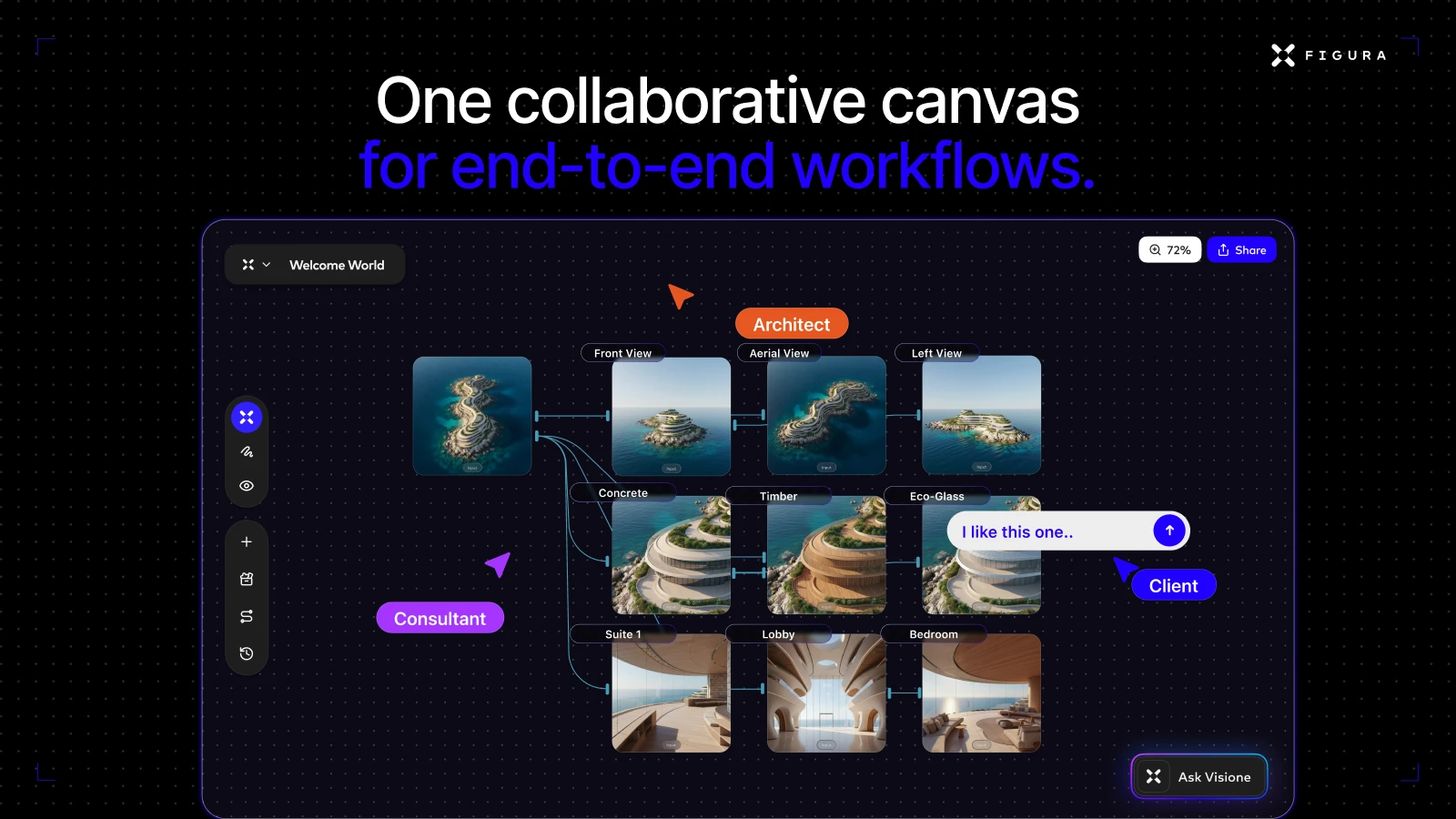
xFigura's collaborative canvas.
I walked the room through one tower, with AI carrying each transition and architects signing off at each stage.
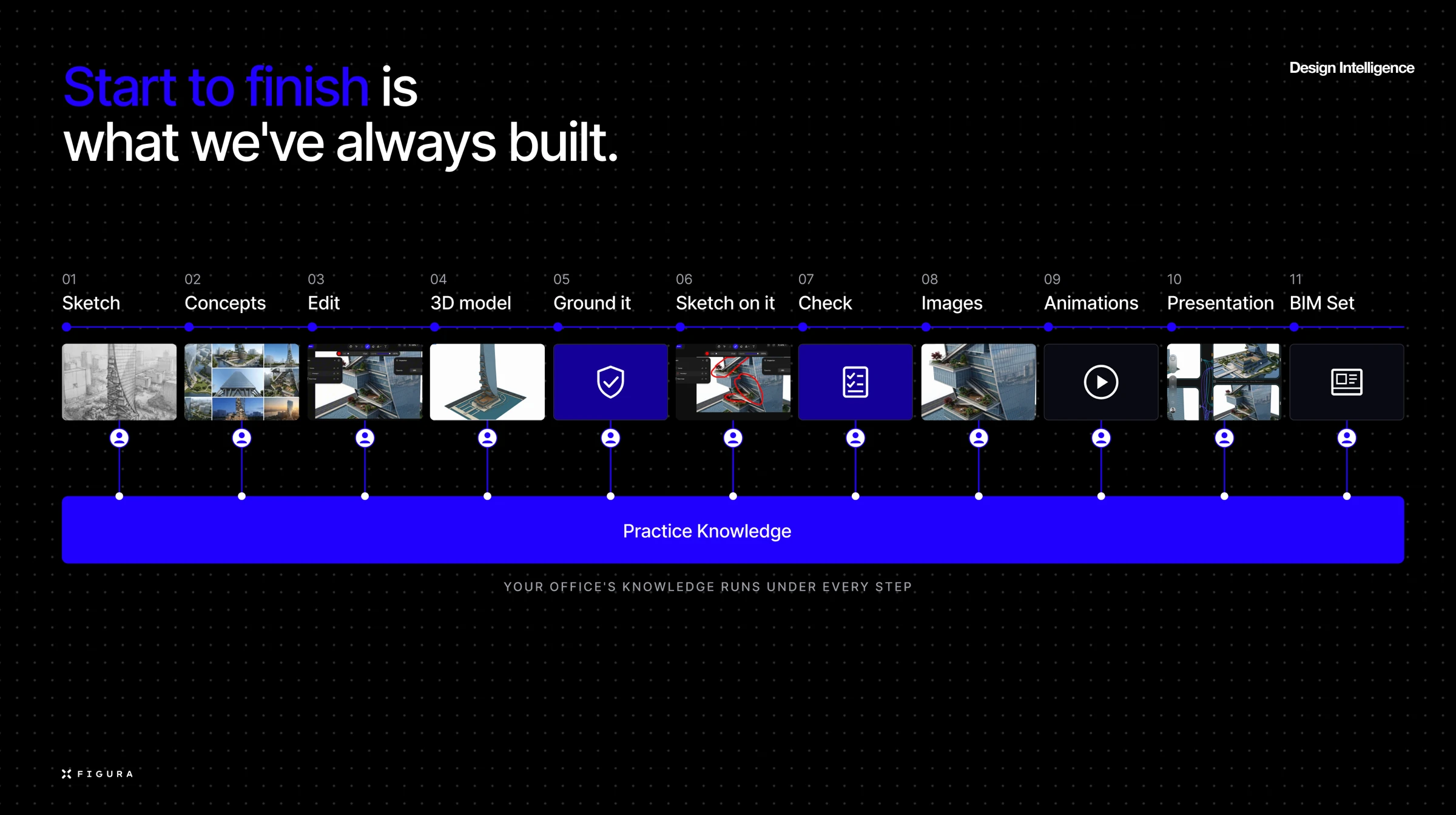
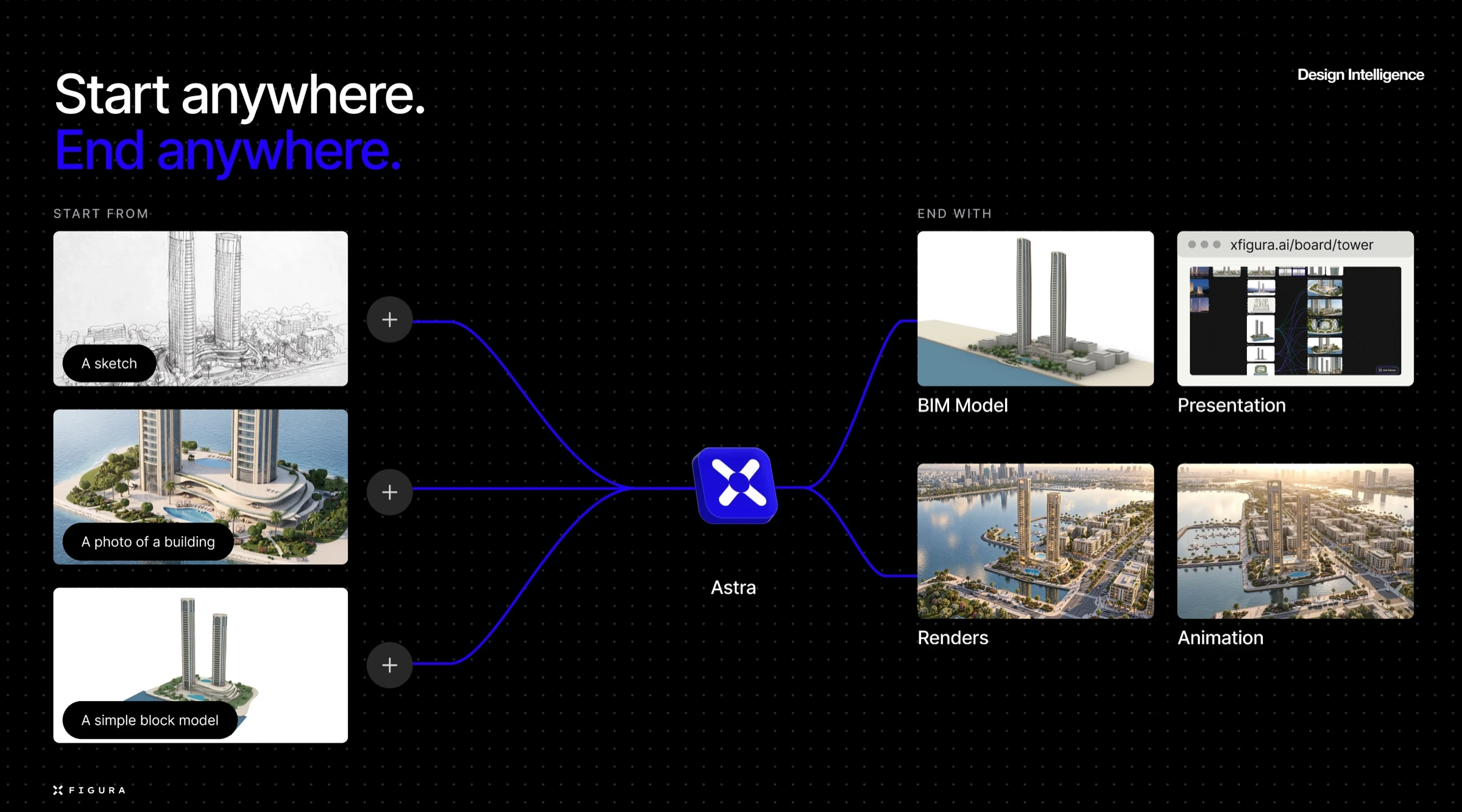
1-2. Sketch to concepts. A pencil sketch, a Rhino screenshot or a physical massing model becomes a concept set of the same building.
3. Edit. Any part of an image can be changed with no degradation elsewhere and no shift in camera, with help from any of the latest LLMs through Visione, our agent.
4-5. 3D with Astra. Astra, OpenAI's newest model, turns one image into an editable 3D model, on the web or in Rhino through our plugin, with Revit coming soon. A single pass produced floor slabs and facade elements in layers the team can keep working on: a day to a week of an architect's time, done in minutes. That model becomes the new ground truth, replacing a set of AI images derived from a massing model. In theory, the pipeline could run on the latest Google and Claude models too, because the model isn't the advantage.
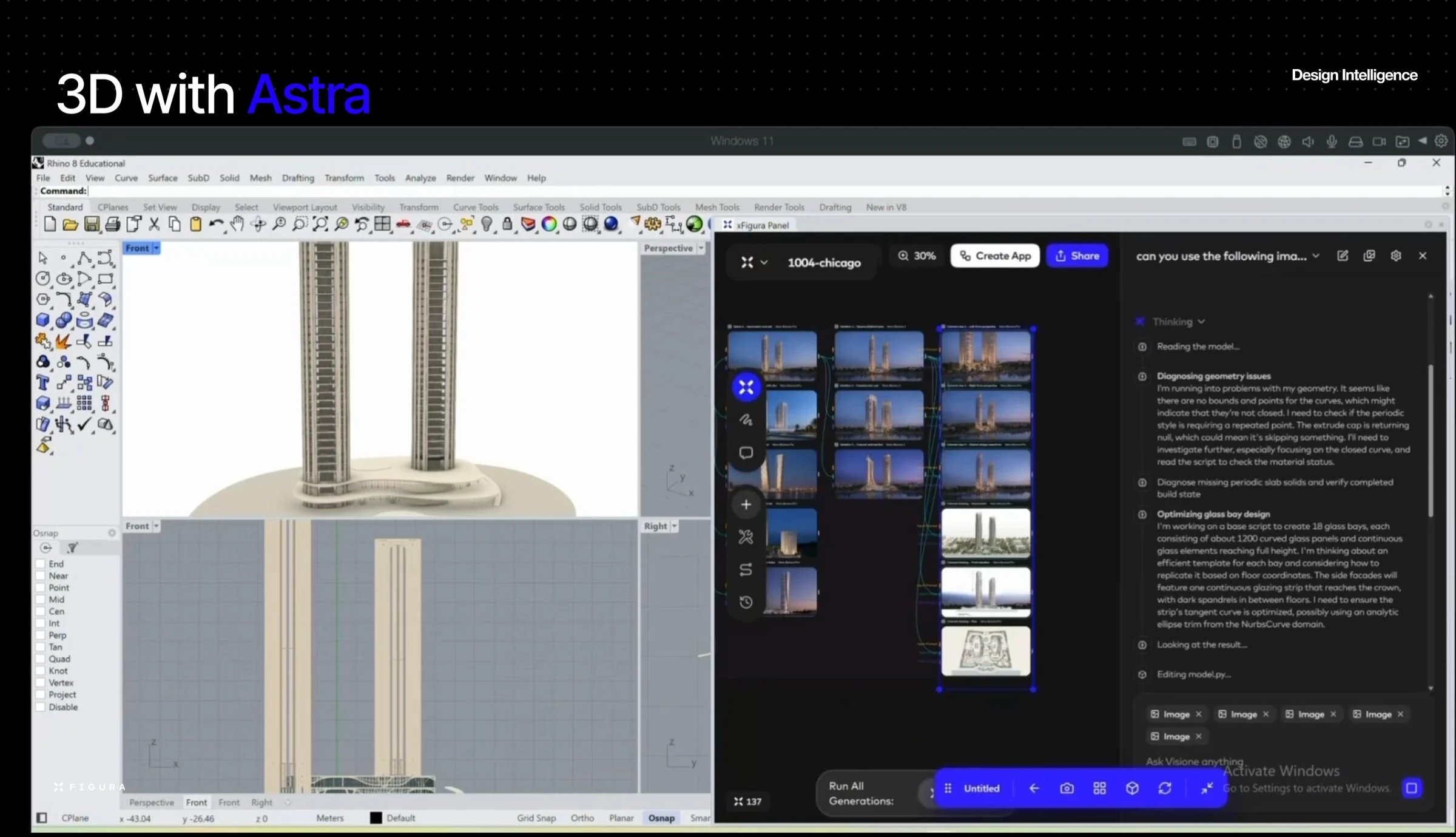
6-7. Sketch and check. Sketch on the model in our live 3D builder and export to .3dm at any time. Test it against a PDF, such as the code for stairs, egress, and floor-to-floor heights. These checks are fast and fairly accurate, but an architect still reviews them. Design isn't linear, so the loop repeats. The model below took 25 minutes and two prompts, from generated images of a single sketch.
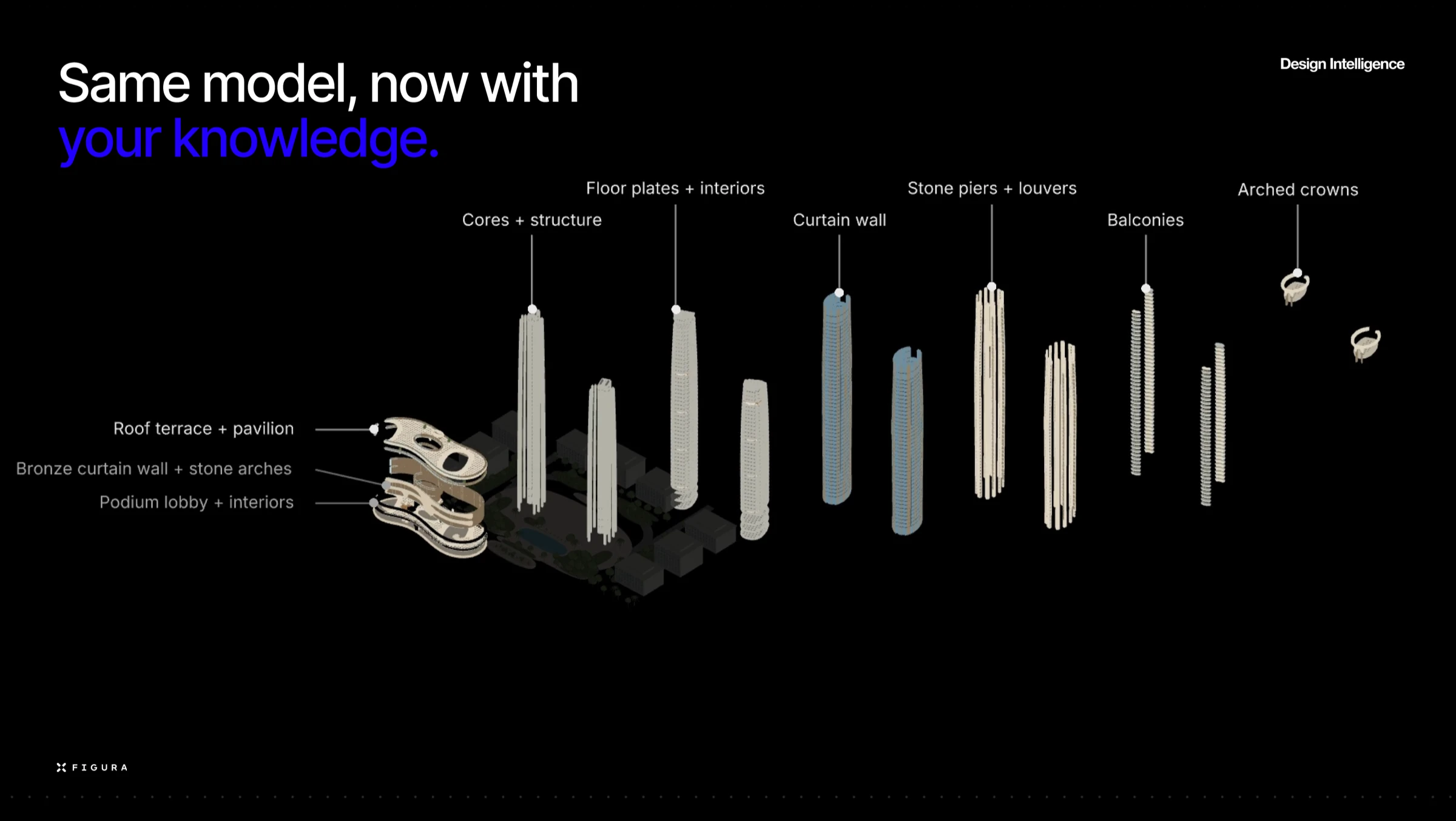
8-11. Everything from one model. Images, a film animation and an early BIM set all come from the same model, so every view shows the same building. Firms can bring in their own materials, specs and asset libraries. The drawing set is a concept-stage first pass, not a construction set, and a person verifies every drawing.
Consider this a V0. Production isn't perfect today. The point is to ask what practice looks like once it's easy to automate, and what that teaches us about how to listen, how to operate, and how to teach.
Knowledge sets the ceiling
Every firm can use the same AI models, but no two firms know the same things. A firm's edge now lives in what it has learned: past projects and standards, proven details, values, client feedback, costs, and hard lessons. Fast Company recently called this a data gold mine that the frontier AI labs can't reach, and firms are already building their own tools to use it.
Architects are rightly protective of their IP and data, which is why our agreements with model providers prohibit training on client data. We work with many of the world's largest firms, including Populous, Arup, KPF, BIG and ZHA, each building internal systems that are now integrated with xFigura.
Foundational knowledge won't stay scarce. I've heard of data companies offering to buy firms' data for hundreds of thousands to millions of dollars. What stays valuable is the reasoning behind decisions and knowledge specific to a typology. We're building toward a secure sandbox for that, where knowledge shapes every step of a project and each project feeds what it learned into the next.
This also changes who can compete. A firm of fewer than ten with deep industry knowledge will be able to deploy hundreds, if not thousands, of agents and deliver work competitive with some of the largest firms. Size used to protect a firm, but now knowledge does. And 40 years of files is not 40 years of knowledge.

Small firms will compete with large firms that have no clear AI strategy.
So where to start? I pointed the room to the AI readiness toolkit from the AIA AI Task Force, of which I'm a member. It opens with a five-question assessment that places a firm on one of four levels, from ad hoc experiments to AI-first firm. Take it, then map what your firm knows and where it lives: databases, consolidation, process.
Judgment is the job
Ask any office how much of its week is actually design, and the honest answer is "not much." The rest is coordination, and every handoff from partner to junior loses a little of the original intent. With AI, could there be a new way to work? Picture five architects in a room for half a day, all on the same live model. They test options, pull in precedents, check code, and reach a decision with the intent intact. AI does the production, and the five of them make the calls together.
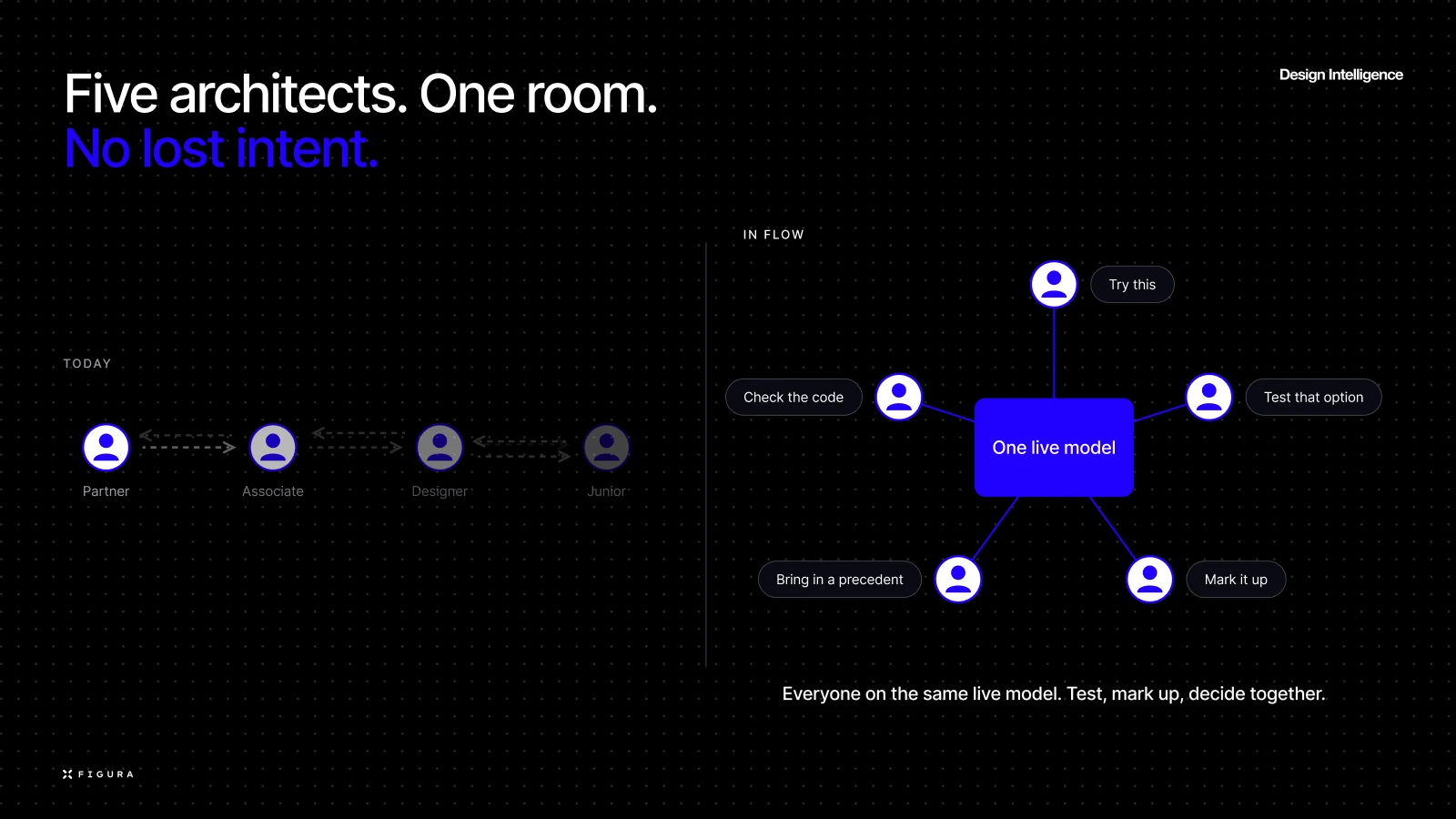
From handoffs to one live model.
Taste comes from design-trained review and years of hard-earned experience. Producing hundreds of thousands of images doesn't make any of them client-ready. In the World Economic Forum's Future of Jobs Report 2025, about seven in ten employers called analytical thinking essential, more than any other skill.
Production work is how juniors have always learned. If AI takes it, firms and schools have to replace that learning on purpose, with more crits, more reviews, and more time beside senior designers. At Harvard, where I've taught in the MDE program, students start with design thinking, systems and ethics, and still sketch and prototype by hand before going deep into building with AI.
Within a few years, AI will make design dramatically faster. It won't replace architects, but once every firm is fast, speed will no longer differentiate firms. Clients will pay for judgment and design quality. Let the increasing efficiency of AI take the work nobody went to architecture school for, and spend the time on design. If firms compete on speed and cut fees, we all lose, which is why I believe groups like the LFRT, the AIA and the RIBA have the task of shaping the future of architecture collaboratively.
The profession will change. We want to be partners in creating this future as architects who stand behind the profession, not behind the automation drive coming from the big labs.
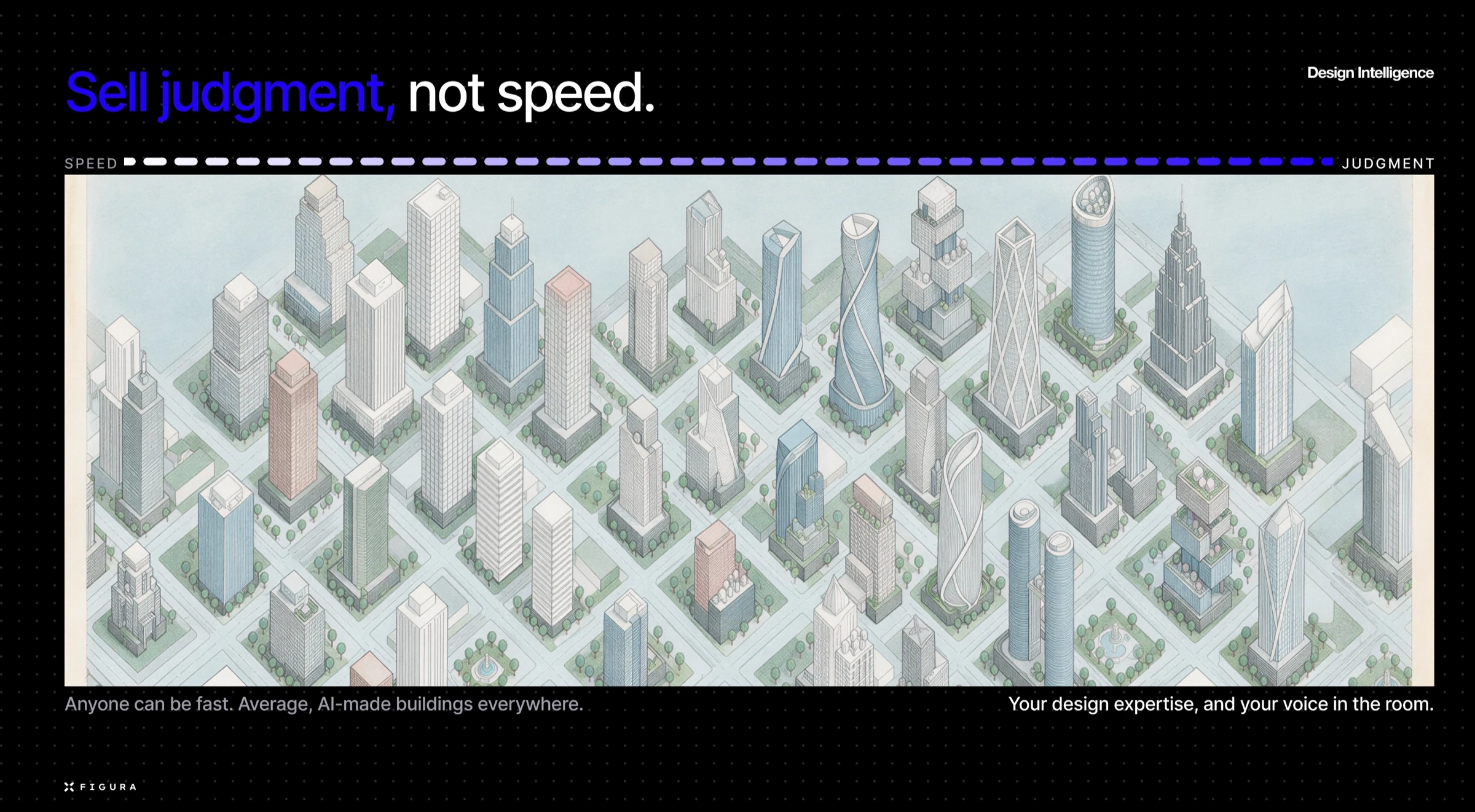
The tool sets the floor, not the ceiling. AI is the first tool that creates with us.
Your knowledge sets the ceiling. A firm's value lives in what it has learned first-hand.
Judgment is the job. Taste comes from design-trained review and hard-earned experience.
My open question back to you: what stance should software take when both automation and professional judgment are expected? I'd love to hear your take.
Until next time,
George Guida
CEO, Founder xFigura
See how KPF, BIG and ZHA are using xFigura, or watch Andy Christoforou, Project Innovation Manager at KPF, on our YouTube channel.
Sources
World Economic Forum, Future of Jobs Report 2025: about 7 in 10 of 1,000+ employers call analytical thinking essential.
Fast Company, "Architects are sitting on a data gold mine", Nate Berg, August 24, 2026.
AIA AI Firm Toolkit: maturity assessment.
Clark Nexsen joins AIA's Large Firm Roundtable: "more than 50 of America's largest architecture firms", meets twice a year.
UW: Student recap of the LFRT Deans' Forum: deans "from universities across the country" meeting with leaders of the top 60 firms.
Tool-evolution diagram adapted from Phil Bernstein (credited on the slide).